Showing posts with label Indian. Show all posts

Tuesday, December 12, 2017

World Rhythms 15: We Have the Beats!

World Rhythms News Banner
Issue 15, Dec. 2017: We Have the Beats!
The World Rhythms News is an infrequent newsletter dedicated to world music education brought to you by the band Ancient Future. Subscribe at Ancient-Future.Com.
In this issue:

Future Possibilities

World Fusion Exercises

When musicians are exposed to the musical knowledge developed by traditions that are not native to their upbringing, new traditions are created. This process is normally an organic one. The more musical knowledge you have, the more that knowledge comes through in the music you create.
But it can be fun to make exercises bringing ideas from different traditions together. The book Ancient Traditions – Future Possibilities: Rhythmic Training Through the Traditions of Africa, Bali and India includes an entire chapter on world fusion exercises. But rather than including a large set of exercises, just a few key examples are presented to inspire you to create your own.
We begin with a world fusion exercise, and then delve into the traditions it is based on.

Tihai Kotèkan

This exercise combines Balinese and North Indian rhythmic concepts. This intermediate level example from Chapter 4, Exercise I, page 127 of Ancient Traditions – Future Possibilities is in a 15 beat rhythmic cycle. Recite the drum syllables of the tihai (North Indian rhythmic phrase that repeats three times and lands on the first beat of the rhythm cycle), starting first with the bottom part of the kotèkan (Balinese interlocking rhythm), and then proceeding to the top and more offbeat part. For an explanation of the notation below, see the North Indian Tala page. Also see the Pronunciation Guide to Indian Drum Syllables.
Play Tihai Kotèkan
    + (hand clap on sam)
15 |dhin * dha ge *   na ge *  ki ta *  ka dhin *   dha ge
4  |dhin * dha *  dhi na *  na ki *  ta ka *    kre dha * 
    1             2            3           4

    2 (hand clap on 2nd tali, or section marker of the tala)
    dhin * * *  * * dhin * dha ge *   na ge * ki ta
    dhin * * *  * * dhin * dha *  dhi na * na ki * 
    5           6          7             8
    0 (hand wave on khali, or empty beat of the tala)
    *  ka dhin *   dha ge dhin *  * * * *  dhin * dha ge
    ta ka *    kre dha *  dhin *  * * * *  dhin * dha * 
    9              10             11       12

    3 (hand clap on 3rd tali)                 +                      
    *   na ge *  ki ta *  ka dhin *   dha ge |dhin
    dhi na *  na ki *  ta ka *    kre dha *  |dhin
    13           14          15               1

Key: Each syllable is a quarter of a beat, or 16th note. An * signifies a rest.

Ancient Traditions

Here we will explain the two traditions behind the above fusion exercise.

Tihai

A tihai is a common North Indian cadential pattern repeated three times in succession. The last note of the cadence is timed to fall either on the sam, the first beat of the tala (rhythmic cycle), or on the the beginning note of a main musical phrase. One repetition of the pattern is known as a pala. Musicians become skilled at fashioning tihais on the spur of the moment to create a cadence, and must continually be aware of where they are in the rhythmic cycle and consequently how many counts are left in which to play a tihai.
In North Indian music, the term laya refers to both the main tempo of the beats in the tala and the relative speed of the notes played during each beat of the tala. Another way to look at the later meaning is that the number of divisions per beat is referred to as the laya. Instead of looking at four notes per beat in 4/4 time as sixteenth notes, the speed of the notes relative to the beats is considered a laya of four, or chaugun laya. Of course, the laya used is an important part of calculating the tihai math.

Tihai Math

Does math make your brain hurt? Then skip to next part. But you will become a better musician if you embrace math.
While North Indian musicians create tihais by a more or less intuitive process gained through years of practice and familiarization with the elements of tala, it is helpful to know mathematical formulas for arriving at tihais, of which there are many. The math behind the above tihai could be expressed using the following formula, which works for all tihais that start on the sam:
G = [(CTL +1) - 3P] ÷ 2, where C = the number of repetitions of the rhythmic cycle required to bring the tihai to sam, T = the number of beats in the tala (rhythmic cycle), L = the number of laya divisions, P = the length of one pala of the tihai expressed in laya divisions, and G = the gap or breath between pala repetitions expressed in laya divisions.
The tihai formula is used to figure out what the the gap or rest between the palas of the tihai needs to be to make the tihai land on sam given the length of the pala, the number of divisions in the laya, and the number of beats in the tala. Here's how the math works for the tihai in the world fusion exercise above:
The tihai takes only 1 cycle of 15 beats with a laya division of 4 notes per beat, so CTL = 1 x 15 x 4, or 60. Therefore, CTL + 1 = 61. One pala of the tihai takes up 17 laya divisions of 4 notes per beat, so 3P = 3 x 17, or 51. Therefore [(CTL +1) - 3P] = 61 - 51, or 10. 10 ÷ 2 = 5, so the gap is equal to 5 laya divisions of 4 notes per beat, or 5 16th note rests.
Try making your own tihai using the G = [(CTL +1) - 3P] ÷ 2 formula!

Kotèkan

A gamelan is an ensemble normally composed primarily of percussion. In Bali, orchestras of tuned gongs, bronze kettles, bronze metallophones, bamboo xylophones, drums, cymbals and flutes fill the night air with animated music. Melodic parts interlock, divided in such a way that musicians play alternate notes to form the melody line. These interlocking parts, known as kotèkan, require cooperation and a keen sense of rhythm to perform. The two parts of a kotèkan, which are thought of as male and female, are known as nyangsih and polos. The main accents of the nyangsih part are usually on the offbeat, while the main accents of the polos part are usually on the beat.
Knowledge of kotèkan can be extremely valuable. These interlocking rhythms have a unique way of bringing people together in cooperation towards a common goal, and there are many creative possibilities for applying them to contemporary music.
Here is an example of a traditional kotèkan. The bottom part is the polos, and the top part is the nyangsih.
Play Kotèkan
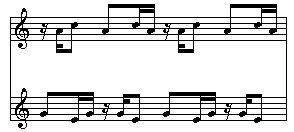
Ochetan Music Notation
Ancient Traditions – Future Possibilities includes a set of cards representing all 26 mathematically possible one beat kotèkan patterns without rests. They are very useful for creating your own kotèkan patterns for pre-existing or yet to be written melodies.

Create Your Own Tihai Kotèkan

Using the tihai formulas and kotèkan cards in Ancient Traditions – Future Possibilities, you can create your own tihai kotèkan. You might even come up with something that will become part of one of your compositions. Tihai kotèkans make for intriguing endings such as the final tihai kotèkan employed on a track released by the band Ancient Future:
"Nyo Nyo Gde" by Matthew Montfort from World Without Walls by Ancient Future: Play on Ethnocloud. Play on Spotify. Play on iTunes.

Where's the Beat?
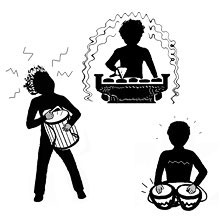
  Talking Drum, Gamelan, and Tabla
A. West Africa, Bali, and India, birthplaces of polyrhythm, gamelan, and tala.
B. Within every performer, where musical dreams are made.
C. In a rhythm training manual by Matthew Montfort called Ancient Traditions – Future Possibilities.
D. In the new companion set from Ancient Traditions – Future Possibilities: Audio Guide and MIDI Groove Tracks from the Traditions of Africa, Bali, and India.
E. Through world rhythm workshops and Skype study with Matthew Montfort.
F. All of the above.

The Answer

If you answered "all of the above," you are well on your way to finding the beat! Read on to find out how a training manual on the rhythms of Africa, Bali and India can help performers of all types reach their musical dreams, enable listeners to get more out of music, and is now bringing these ancient rhythms into the grooves of the future with the release of an audio companion edition for digital audio workstations, sequencers, computers, tablets, smartphones, CD players and other gizmos!

The Beginning, the Beat, the Book

Book Cover

Ancient Traditions – Future Possibilities: Rhythmic Training Through the Traditions of Africa, Bali and India. By Matthew Montfort. Mill Valley: Panoramic Press, 1985. ISBN 0-937879-00-2. Comb Bound Book- $46.95 (SALE $33.95). Book and Enhanced Audio CD Set with MIDI files- $74.95 (SALE $53.95). New Best Buy! Book & Audio Guide/MIDI Download- $69.95 (SALE $49.95).
This classic "world beat bible" by Matthew Montfort takes the student on a musical voyage through the ancient rhythmic traditions of Africa, Bali, and India with a series of exercises that require no instruments to perform. Interesting, imaginative and fun, these rhythm exercises will be of immense help to all music lovers, not just percussionists. Indeed, Matthew Montfort, leader of the trailblazing world fusion music group Ancient Future, was inspired to write the book because it was difficult for him to find musicians who had the skills to perform multi-cultural music. By enabling home study of non-Western rhythms with enough material for years of practice for most students, the training develops refined rhythmic skills, promotes multi-cultural musicianship, stimulates new ideas for composers and improvisers, and fosters cross-cultural music appreciation.

The New Audio Guides and Grooves
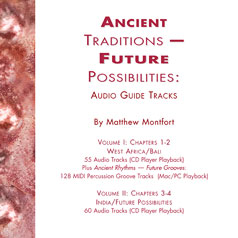
A.T.F.P. Audio Guide Tracks

Ancient Traditions – Future Possibilities: Audio Guide and MIDI Groove Tracks from the Traditions of Africa, Bali, and India. By Matthew Montfort. Ancient Future Music (AF-0001, 2005. V 4.0, 2017). New Preview Release! Companion MP3/MIDI Guide Tracks Download Set- $34.95 (SALE 24.95). Companion Audio/MIDI Guide Tracks 2 Volume CD/CD-ROM Set- $39.95 (SALE $29.95).
A new downloadable companion set of MP3 audio guide and MIDI groove tracks of the exercises in the book Ancient Traditions – Future Possibilities will be released in fall 2017. The preview beta release is on sale now at Ancient-Future.Com. The downloads are set up for playback on Mac and PC computers, tablets, and smartphones. The tracks are also available on a CD/CD-ROM set.
West African drum music, Balinese gamelan, and Indian tala are oral traditions, and the new downloadable files make it very convenient to integrate the tradition of learning by ear into the rhythm studies. The material is presented in two complimentary formats: audio guide tracks and MIDI groove tracks, which are also available separately as downloads.

The Audio Guide Tracks

Ancient Traditions – Future Possibilities: MP3 Audio Guide Tracks. By Matthew Montfort. Kentfield: Ancient Future Music (2005). New Preview Release! Companion MP3 Audio Guide Tracks Download- $24.95 (SALE 17.95).
Ancient Traditions – Future Possibilities: Audio Guide Tracks is a set of 115 audio guide tracks of the exercises in Ancient Traditions – Future Possibilities that help facilitate correct practice habits. The download version is divided into three zipped folders of MP3 files. Volume I covers the exercises in Chapter 1, West Africa, and Chapter 2, Bali. Volume II A covers the South Indian exercises in Chapter 3, India. Volume II B covers the North Indian exercises in Chapter 3, India, and Chapter 4, Future Possibilities. Two printable .pdf booklets are included: the A.T.F.P Audio Guide Tracks CD Booklet, a wrap around CD booklet with instructions for burning CDs if desired, and the A.T.F.P Audio Guide Track List, which includes the names, durations, tempo settings, and book page numbers for all 115 audio guide tracks.

The MIDI Groove Tracks

Ancient Rhythms – Future Grooves: MIDI Percussion Groove Tracks from the Traditions of Africa, Bali, and India. Version 4.0. By Matthew Montfort. Kentfield: Ancient Future Music (1997. V. 4.0 2017). New Preview Release! MIDI File Download- $24.95 (SALE 17.95).
Ancient Rhythms – Future Grooves: MIDI Percussion Groove Tracks from the Traditions of Africa, Bali, and India is a complete set of 128 MIDI tracks that playback in Standard MIDI File compatible web browsers. For greater control or for use as rhythm tracks in audio productions, load them into a MIDI sequencer app (Mac, PC, iOS, Android, etc.) to loop tracks, change the tempo, or listen to individual parts. The files come arranged for General MIDI percussion and can be remapped to other instruments using the included MIDI maps with explanations of the sounds of West African drums, Balinese gamelan, South Indian mridangam, and North Indian tabla. A full set of tabla samples is included along with supporting files for using them with VSTi instruments (PC) and GarageBand (Mac).

The Beat

The Eve Orchestra of West Africa

The Eve people of the island town of Anyako off the coast of Southeastern Ghana have developed a music rich in polyrhythmic interplay, such as in the drum music of takada, a dance and drumming club developed by the Eve women. The instruments of their percussion orchestra are detailed in the West African section of Ancient Rhythms – Future Grooves. The exercises are arranged for General MIDI agogo, bongo, conga and maracas. MIDI maps of the Eve instruments are included for those who want to experiment with different drum sounds.

The Interlocking Rhythms of Balinese Gamelan

A gamelan is an ensemble normally composed primarily of percussion. In Bali, orchestras of tuned gongs, bronze kettles, bronze metallophones, bamboo xylophones, drums, cymbals, and flutes fill the night air with animated music. Melodic parts interlock, divided in such a way that musicians play alternate notes to form the melody line. These interlocking parts, known as kotèkan, require cooperation and a keen sense of rhythm to perform. The Balinese section of Ancient Rhythms – Future Grooves details the music and instruments of the Gamelan Semar Pegulingan and other ensembles.

The Rhythmic Cycles of India

The perception of the cyclic nature of life is reflected in Indian classical music through the device of tala, a recurring time-measure or rhythmic cycle. There are two different traditions in Indian classical music, the Carnatic music of South India and the Hindustani music of North India.
The tabla is a North Indian drum set comprised of two drums with goat-skin heads. For every sound on the drum there is a corresponding syllable. These syllables are known as bols. Each North Indian tala has a theka, a standard set of bols that identify the rhythmic cycle. The MIDI files of these thekas are arranged for General MIDI conga and bongo, and make excellent groove tracks for creating compositions or practicing. The North Indian section of Ancient Rhythms – Future Grooves features a full explanation of the tabla bols complete with audio links to tabla samples of each bol, and files for VSTi instruments and GarageBand that remap the MIDI files to the included tabla samples.
The mridangam is a South Indian two-headed barrel drum made of jackwood with goatskin heads. South Indian drumming has a language all of its own known as solkattu. For the sounds produced by the mridangam, there are corresponding syllables known as konokol. The South Indian section of Ancient Rhythms – Future Grooves features an explanation of the konokol syllables used in the solkattu compositions that are presented. The South Indian rhythm exercises have been arranged for General MIDI conga and bongo. Instructions and sequencer files are included to help in remapping the MIDI files to tabla or mridangam samples.

The Author
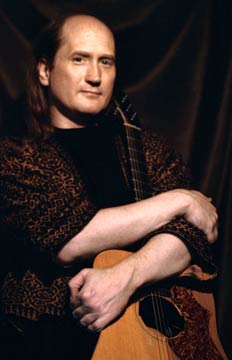
Matthew Montfort

Scalloped fretboard guitar pioneer Matthew Montfort has devoted his life to cross-cultural music through his role as the leader of the world music group Ancient Future. He spent years of study with some of the world's best musicians, such as gamelan director K.R.T. Wasitodipuro, North Indian sarod master Ali Akbar Khan, and vina master K.S. Subramanian, with whom he did an intensive study of South Indian note-bending techniques. He has recorded with legendary world music figures ranging from Bolivian panpipe master Gonzalo Vargas to tabla maestros Swapan Chaudhuri and Zakir Hussain, and performed concerts worldwide, from the Festival Internacional de la Guitarra on the golden coast of Spain to the Festival of India in Mumbai. He has taught masterclasses at prestigious universities, schools, camps, museums, and resorts, and has over four decades of teaching experience, including two on the faculty of Blue Bear School of Music in San Francisco. He is recognized as one of the world's 100 Greatest Acoustic Guitarists by DigitalDreamDoor.com, a curated "best of" site, along with such luminaries as Michael Hedges, Leo Kottke, Merle Travis, John Renbourn, Tommy Emmanuel, and Alex De Grassi. He was interviewed in the December 2009 Les Paul issue of Guitar Player Magazine about the scalloped fretboard guitar and the application of the rules of Indian raga to the music of Jimi Hendrix as exemplified by "Purple Raga" from his debut solo recording, Seven Serenades for Scalloped Fretboard Guitar.

The Workshops and Skype Lessons

Matthew Montfort offers instruction based on Ancient Traditions – Future Possibilities through online lessons via Skype and rhythm workshops at conservatories, public schools, and resorts.

The Quotes

"You can view this deceptively slim masterwork from a few different angles: as a friendly yet serious appetizer on three of the most sophisticated rhythm systems on earth; a chance to work on your rhythmic sight reading; a three-culture dip with matching mp3s for your ears; a gateway to exotic spices, complete with MIDI files, for your songwriting or drumming; or a fun way to organically digest complex time signatures. No matter how you slice it, this scholarly labor of love is packed with rich flavors for those patient enough to harvest them." – E.E. Bradman, Bass Player Magazine
"You've heard Afro-Pop, sitar, gamelan and world music for years. But do you know what they are and how they work? Better yet, would you like to play those twisted cross-rhythms and melodies? In Ancient Traditions – Future Possibilities, Matthew Montfort, a founding member of the world music band Ancient Future, has put together the book for people who want to dig into world music with both hands. The first section of the book covers traditional music of West Africa, Bali and India with theories and exercises. Wherever possible, Montfort has provided beat counts alongside the standard musical notation so even if you can't read music, you can still learn the rhythms. The last section of the book mixes patterns from different cultures, demonstrating the powerful music these simple exercises can generate." – Richard Kadrey, San Francisco Chronicle
"A hands-on exploration of Balinese, African, and Indian rhythms that should appeal to all musicians. One needn't play percussion instruments, or any instruments at all, for that matter, to use and benefit from the book." Drums and Drumming
"A very practical manual. There is enough material to keep interested musicians busy for years. Montfort has done a great service for western musicians interested in world music. A pleasure to work with."Option
"Very highly recommended for any instrumentalists hoping to expand their rhythmic horizons. If you've never investigated the beautiful clash of African polyrhythm, the incredible interlocking textures of Balinese music, or the complex metric structure of Indian classical music, check out Ancient Traditions – it will blow your mind and deepen your groove."Guitar Player
"If you're tired of programming your drum machine with the same old 4/4 back-beat, or you want to sharpen your rhythmic chops, this book is highly recommended."Electronic Musician

The Performers

Ancient Traditions – Future Possibilities has been used and admired by many teachers and musicians around the world.
Lou Harrison (1917-2003), prominent composer and founder of the American gamelan movement, called the work "a very useful contribution to musical scholarship."
Reinhard Flatischler, founder of the TaKeTiNa rhythm training process, was an early enthusiast of the method book.
John Bergamo (1940-2013), composer and coordinator of the percussion department at the California Institute of the Arts, found a copy of Ancient Traditions – Future Possibilities when he cleaned out his desk at retirement. As he finally had the time available, he worked his way through it, after which he called the author to thank him for writing it, and encouraged him to write more world music training manuals. One is in the works.
Steve Smith, stellar jazz and rock drummer of Journey fame, went through the book in preparation for a percussion summit with tabla master Zakir Hussain.
Start your own journey to musical excellence with Ancient Traditions – Future Possibilities!

All compositions, recordings, video, and text in this article © 2017 Ancient Future Music. All rights reserved.

Tuesday, July 29, 2014

World Rhythms News 14: North Indian Raga and Tala

World Rhythms News Banner
Issue 14. Summer 2014:
Welcome to the World Rhythms News, an infrequent newsletter dedicated to world music education written by Matthew Montfort, leader of the band Ancient Future.

In this issue:

Section One: North Indian Raga and Tala
Section Two: Further Study


Section One: North Indian Raga and Tala

Raga

Close Up of Pandit Habib Khan Playing Sitar
A raga is a melodic recipe for a mood. Raga could be described as a "super scale" using a set of notes in ascending (arohi) and descending (avarohi) order, sometimes including prescribed alternate routes, a hierarchy of note importance, and a key phrase that shows the heart of the movement of the raga. This ancient system is both an art and a science of how musical notes create certain moods. The recipe for each raga holds the key to an unlimited number of potential melodies, each perpetuating the mood contained in the raga.

Rag Kalyan

Rag Kalyan is an evening raga that falls within a scale corresponding to the Western Lydian mode, which is a major scale with an augmented fourth. From C, the scale would be as shown below (a dote above a note indicates the octave above, a dot below indicates the octave below):
                             .
C   D   E   F#   G   A   B   C
                             
1   2   3   #4   5   6   7   8

But Rag Kalyan is more than just a scale. Ascending passages start on the major seventh below the root, and skip the tonic and often the fifth:
                         .
B   D   E   F#   A   B   C
.
7   2   3   #4   6   7   8

Descending passages employ the full scale:
.
C   B   A   G   F#   E   D   C

8   7   6   5   #4   3   2   1

The vadi, or dominant note of a raga, is the major 3rd. It can be a note that passages pause on. The samavadi, the second-most prominent note, is the major 7th, which is the note ascending passages start on.

Rhythmic Cycles

Photo o Bayan

The concept of the ever-recurring cyclic rhythms of the universe is one of the basic tenets of Hindu philosophy. The perception of the cyclic nature of life is reflected in Indian classical music through the device of tala,  a recurring time-measure or rhythmic cycle.

In the same way that raga can be described as a “super scale,” tala is a “super time signature,” a recurring time-measure or rhythmic cycle with distinct sections. The beats have different degrees of emphasis within a tala, and are marked with a system of hand claps, hand waves and movements of the fingers. The most important point of rhythmic emphasis is the sam, the first beat of the tala and point to which all variations eventually return. It is represented by the symbol "+," and is marked by a hand clap. The khali,  literally the empty beat, is the unaccented beat of the tala. The lack of accent is emphasized, making the khali a very important beat. It is marked by a wave of the hand and is written with the symbol "o." Talas have other accented beats known as tali, also marked by hand claps. In written notation, the tali are numbered, starting with the number two. In this presentation, each beat is equally subdivided by the number of syllables it contains. For example, in beat one of matta tal, the syllable "dhin" is equal to one beat, and in beat two "terikita" is played as four sixteenth notes. To practice reciting theka, use this pronunciation guide to Indian drum syllables.

There are an estimated 350 talas in North Indian music, of which ten are in common use. Presented here is the most common tala, the 16 beat tintal, and one of the least, the nine beat matta tal. Each tala has a theka, which is a standard groove represented by onomatopoeic drum syllables and played as an accompaniment. Click on the tabla head Tabla Audio Icon below to hear audio of the thekas:


Tabla Audio IconTintal

16 beats, divided 4 + 4 + 4 + 4:

   +                   2                   

|: dha  dhin dhin dha  dha  dhin dhin dha

   1    2    3    4    5    6    7    8   


   o                   3     
 
   na   tin  tin  ta   ta   dhin dhin dha :|

   9    10   11   12   13   14   15   16

 
Tabla Audio IconMatta Tal

9 beats, divided 4 + 2 + 3. In this case, the final 3 beats are subdivided 1 1/2 + 1 1/2: 

   +                                       o
|: dhin      terikita  dhin      na        tin       na 

   1         2 e + a   3         4         5         6
   1         2         3         4         5         6            
                   
 2
 
 dhin dhin na   dhin dhin na  :|

 7    +    8    +    9    +

 1    2    3    1    2    3
    

'Yearning for the Wind' Video in Rag Kalyan and Matta Tal

Yearning for the Wind on YouTube
YouTube Video of 'Yearning for the Wind' with Matthew Montfort and Vishal Nagar
Reached the #1 Position on the Ethnocloud World Music Chart

Recorded in hi-res audio and video in December 2013, Yearning for the Wind is the first audio/video release in Ancient Future history. This evocative piece was produced for the Archive of Future Ancient Recordings, Ancient Future's ambitious ongoing fan-funded project. Yearning for the Wind is the first EP and video to be released to raise awareness of the archive.

Composed by scalloped fretboard guitar innovator Matthew Montfort, Yearning for the Wind is a poignant piece based on Rag Kalyan. The composition also incorporates harmony and other guitaristic elements, and in passages follows the muse of the moment over the rules of raga.

Yearning for the Wind on YouTubeYearning for the Wind on YouTube

Yearning for the Wind starts with an alap, an introductory melodic improvisation that shows how the raga moves. This short alap truncates some of traditional forms that are used in longer expositions. It starts slow and unmetered, but instead of developing into a traditional jor, the section of the alap in which a steady pulse appears, it introduces harmonies as a way of increasing intensity.

Once the alap comes to a conclusion, the slow gat, or main theme, is introduced in the tala. The nine beat matta tal provides an intriguing setting for this duet with Indian tabla virtuoso Vishal Nagar, who is considered one of the most gifted tabla players of his generation. The gat starts with the main melody in the lower register, or the asthai, followed by the antara, a second section of the melody in the higher register. Then there is a melodic guitar improvisation over the tala with a light harmonic rhythm guitar background instead of the traditional drone.

After the gat is reprised, a new theme is introduced that puts a phrase of four against the final three beats of the nine beat tala. It is used as a lahara, an ostinato employed to accompany a tabla solo. Vishal begins his solo by exploring the main tabla sounds which flow with the soft groove of the nine beat rhythm. He slowly builds up to a vibrant rela (a fast tabla composition characterized by rapid drum rolls) utilizing a tishra jati (triplet) bridge that draws from the end of the matta tal theka for a graceful transition that remains attuned to the mood of the composition.

The fast gat that follows also employs the phrasing of four against the final three beats of the tala. There is another improvised guitar solo, followed by a fixed ending that employs a guitaristic riff followed by a tihai: a rhythmic phrase repeated three times and timed to end on the sam, the first beat of the tala. In this case, the tihai has a high ostinato played against it by the rhythm guitar that helps further enhance the climax of the tihai. This is followed by the lahara, this time played in the high register, with a second (and faster paced) tabla solo, followed by another tihai, into a restatement of the antara of the fast gat, followed by the final tihai. The piece ends with the rhythm guitar fading on an accompaniment ostinato similar to what a swarmandal, or Indian harp, might play.

Yearning for the Wind Cover
Yearning for the Wind by Ancient Future. Ancient-Future.Com AF-90352. Signed Enhanced Audio/Video E-CD-R-$17.98: Buy E-CD Now. iTunes.


Section Two: Further Study

Rhythm Training Book Sale

Ancient Traditions--Future Possibilities Book

Ancient Traditions - Future Possibilities

Book/Enhanced Audio CD Set with MIDI Soundfiles: $52.95 (SALE! Normally $69.95): Buy 1 Now.
"You've heard Afro-Pop, sitar, gamelan and world music for years. But do you know what they are and how they work? Better yet, would you like to play those twisted cross-rhythms and melodies? In Ancient Traditions--Future Possibilities, Matthew Montfort, a founding member of the world music band Ancient Future, has put together the book for people who want to dig into world music with both hands. Wherever possible, Montfort has provided beat counts alongside the standard musical notation so even if you can't read music, you can still learn the rhythms." – Richard Kadrey, SAN FRANCISCO CHRONICLE

Music Lessons Via Skype

Skype Pick Icon

And Other Multimedia File Exchange Methods

Private Lessons with Matthew Montfort

Study any of the subjects on the education section of Ancient-Future.Com through private correspondence lessons (via Skype or any method of file exchange) with Ancient Future bandleader and guitarist, Matthew Montfort. Feel free to email info@ancient-future.com with any questions you may have about how correspondence lessons can help you in your musical development!

All compositions, recordings, video, and text in this article © 2014 Ancient Future Music. All rights reserved.

Wednesday, July 2, 2014

1st Audio/Video Release in Ancient Future History, 2 New Tracks, 3 Concerts, 4 CDs on Sale, 5 #1 Videos

Ancient Future Times
Twitter: Ancient Future Band (Ancient_Future)
Facebook: Ancient Future Fan PageMatthew Montfort Fan Page
July 2014 Issue:
One New Release
•First Audio/Video Release in Ancient Future History
Two More A.F.A.R.
•Two New Tracks Added to the Archive of Future Ancient Recordings
Three Concerts
•Lick Observatory, Incline Village, Reno

Four for Forty
• Four Acclaimed Releases Just $10 Each
Five #1 Videos
14 Number 1 Chart Positions on Ethnocloud, June 1, 2014

One New Release

First Audio/Video Release in Ancient Future History
Yearning for the Wind Cover
Composed by scalloped fretboard guitar innovator Matthew Montfort, Yearning for the Wind is a poignant piece based on Rag Kalyan, an evening raga that corresponds to the Lydian mode. The composition in three movements also incorporates harmony and other guitaristic elements. A duet with Indian tabla virtuoso Vishal Nagar, who is considered one of the most gifted tabla players of his generation, Yearning for the Wind is set in matta tal, a nine beat rhythmic cycle. As a bridge between the slow and fast sections of the piece, Vishal Nagar performs an elegant tabla solo over the soft nine beat groove that slowly builds up to a vibrant rela (a fast tabla composition characterized by rapid drum rolls).
Recorded in December 2013, Yearning for the Wind was produced for the Archive of Future Ancient Recordings, Ancient Future's ambitious fan-funded recording project. The digital preview release of Yearning for the Wind is available now at iTunes and other digital retailers as an mp3 and video download. The enhanced CD version (an audio CD with a CD-ROM session for computers with liner notes and an HD video with 96/24 hi-res audio) will be released at fine stores such as Ancient-Future.Com and Amazon.com starting July 22, 2014. This is the first audio/video release in Ancient Future history, just in time for the band's 35th anniversary year!
Yearning for the Wind by Ancient Future. Ancient-Future.Com AF-90352. Signed Enhanced Audio/Video E-CD-R-$17.98: Buy E-CD Now. (Ships by 7/22/14)

Two More A.F.A.R.

30th Anniversary CD Mystery Cover
On February 11, 2014, the exact 35th anniversary of the first Ancient Future concert, two new studio tracks were added to the Archive of Future Ancient Recordings, which now has 70 minutes of music in it!
The first track added was Yearning for the Wind. More than five months before its E-CD release, it was made available to supporters of the archive in mp3, CD quality, 96-kHz/24-bit hi-res audio, and a full resolution HD video that is higher quality than is possible for E-CD or iTunes release.
The second track added, East of the Sun, reunites original Ancient Future members Matthew Montfort and Benjy Wertheimer with help from Paul McCandless of the band Oregon. The basic tracks for this poignant piece with an Afro 5/8 groove and a haunting melody were recorded live in the studio on 4/1/2011 by Matthew Montfort on scalloped fretboard guitar, Benjy Wertheimer on tabla, and Mariah Parker on santur. Additional scalloped fretboard guitar and fretless bass parts by Matthew Montfort and oboe parts by Paul McCandless were recorded in Ancient Future's newly upgraded home studio in 2013, producing this lush new quintet version. It is available to supporters of the archive in mp3, CD quality, and 96-kHz/24-bit hi-res audio file formats.
Now that the music business has collapsed due to the tech industry's successful promotion of the meme that content should be virtually free, Ancient Future really truly needs YOUR support in order to continue to bring you music. Streaming companies are valued in billions of dollars, but streaming royalties are measured in thousandths of a cent, so is imperative for everyone who reads this newsletter to help in some way. Please become a supporter at one of the levels below, starting at just $15. Please let your friends know about this opportunity to support world fusion music. Share this newsletter, and share Ancient Future posts on social networks. And if you can afford it, please consider making a VIP donation to move the project along faster.
Recording Newsletter. $15 (receive 128 kbps downloads): Subscribe @ $15. Download Supporter. $25 (320 kbps downloads): Subscribe @ $25. Limited Edition CD Sponsor. $50 (all previous plus CD quality audio): Subscribe @ $50. Honorary A & R Representative. $75 (all previous plus video and 24 bit audio): Subscribe @ $75. Donor VIP. Make Additional Donation.

Three Concerts

Ancient Future Concerts in California and Nevada

Ancient Future Trio

Photo of Mariah Parker, Matthew Montfort, and Vishal Nagar
Featuring Mariah Parker, Matthew Montfort, and Vishal Nagar
Saturday, July 19, 8:30 p.m.
Benefit Concert for UCO Lick Observatory
Main Building Hall
Mount Hamilton, CA 95140
Adm: $40 general seating, $100 preferred, $150 VIP. Tix: UCSC ticket office 831-459-2159 after May 1. Info: 408-274-5061, www.ucolick.org.
This trio version of Ancient Future will perform music from Ancient Future's many recordings, including their latest release, Yearning for the Wind. The program includes the concert, astronomy lecture, and (weather permitting) viewing through the historic 35-inch Great Lick Refractor and the 40-inch Nickel Reflector telescopes!
Matthew Montfort is Ancient Future's leader and has released two solo guitar releases: Seven Serenades for Scalloped Fretboard Guitar and Sympathetic Serenade, for which he was lauded as one of the world's 100 Greatest Acoustic Guitarists by DigitalDreamDoor. Montfort is a pioneer among guitarists who have had their fretboards scalloped in order to play various forms of world music that require intricate note-bending ornaments while still being able to play chords.
Vishal Nagar is considered one of the most gifted tabla players of his generation. Born into a family of musicians, Vishal has been surrounded by music in an extremely musically creative and artistic environment. Vishal had his initial training with the late Ustad Latif Ahmed Khan of the Delhi Gharana. After his Ustad's untimely demise, Vishal continued his training under the guidance of Ustad Shamim Ahmed Khan. He also has had intense rhythmic training from his mother, the renowned and highly respected Kathak dancer and vocalist, Urmila Nagar.
Mariah Parker is a composer and multi-instrumentalist. She released her first solo recording of her compositions, Sangria (Ancient-Future.Com AF 2017), in 2009. Her CD release party drew a full house at the famous Yoshi's Jazz Club in Oakland for her Indo Latin Jazz Ensemble, which features a stellar lineup of musicians including the Grammy-winning Paul McCandless of the group Oregon.

Ancient Future Hammered and Picked Duet

Photo of Mariah Parker and Matthew Montfort
Hammered & Picked: World Folk for Guitar & Dulcimer
Featuring World Guitar Pioneer Matthew Montfort and Composer/Hammered Dulcimerist Mariah Parker

Friday, July 25, 7:00 p.m.
Sierra Nevada Guitar Festival
St. Patrick's Episcopal Church

341 Village Blvd.
Incline Village, NV 89451
Suggested donation: $20 for adults
Info: music@sierraguitar.org
Ancient Future's Matthew Montfort (scalloped fretboard guitar) and Mariah Parker (hammered dulcimer) will perform material from the band's many recordings influenced by Celtic, Latin American, Indian, Arabic, Spanish, European and American music. They will be joined by special Tahoe area guests including world dancer/violinist Sapphira and guitarist/cellist Larry Aynesmith.

Ancient Future Guitar and Tabla Duet

Featuring World Guitar Pioneer Matthew Montfort and Tabla Virtuoso Vishal Nagar plus Special Guest Mariah Parker
Photo of Matthew Montfort and Vishal Nagar
Shown: Matthew Montfort and Vishal Nagar
Sunday, July 27, 3:00 p.m.
Reno Artown Festival
Mathewson-IGT Knowledge Center

Wells Fargo Auditorium, Room 124
University of Nevada, Reno
Reno, NV 89557
Info: 775-298-1893
Suggested donation: $5 children, $15-$20+ adults.

Strains of passionate flamenco and ethereal Indian raga emanate from this improvisatory duet featuring world guitar pioneer Matthew Montfort accompanied by renowned Indian tabla virtuoso Vishal Nagar.


Four for Forty

Planet Passion CD CoverSangria CD CoverSeven Serenades CD CoverSympathetic Serenade CD Cover

Four Releases Just $10 Each

Ancient Future Summer Sale

Five #1 Videos

Ethnocloud Charts
Ethnocloud 6-1-14.pdf (8 MB pdf)
14 Number 1 Chart Positions on Ethnocloud, June 1, 2014
As evidenced by the above 15 page media report, this spring, Ancient Future rose to the top of the Ethnocloud music charts, briefly garnering 14 number one spots in the following categories: Artist by Rating, Top 40 March 2014 Video, Top 40 April 2014 Track, Top 40 April 2014 Video, Video by Rating, Track by Rating, India Influence Video, Gypsy Influence Video, Asian Influence Video, Middle Eastern Influence Video, North American Influence Video, India Influence Track, Middle Eastern Influence Track, and East European Influence Track.
This issue of the Ancient Future Times features five videos that each earned number one spots on Ethnocloud!

Yearning for the Wind

Yearning for the Wind on Ethnocloud
Yearning for the Wind rose to the top of the Ethnocloud World Music Charts, earning #1 spots in both the Video and Track categories for the April 2014 Top 40, and propelling Ancient Future to the #1 rated artist spot in early June, 2014. It is currently the #1 Video by Rating and #1 India Influence Video. The camera work and video editing was done by Michael Bradon at Seven Channel Sound.

Matthew Montfort and Shenshen Zhang

Matthew Montfort (scalloped fretboard guitar) and Shenshen Zhang (pipa) on Ethnocloud
This video captures the very first time that Chinese pipa master Shenshen Zhang and scalloped fretboard guitar pioneer Matthew Montfort played together. They met at an acoustic guitar concert set up by steel string guitarist Mike Kostowskyj in Half Moon Bay. Mike invited Shenshen Zhang to perform a number by herself. Matthew was impressed and invited her to jam with him, and this is exactly what happened from their first note together! The unedited video was recorded by Mariah Parker from the audience. It is currently the #1 Asian Influence Video on Ethnocloud, and was the #1 video on the Ethnocloud Top 40 for March 2014.

Prelude and Bookenka (The Adventurer)

Prelude and Bookenka on Ethnocloud
Recorded at Ancient Future's concert at the Freight and Salvage October 16, 2013, this is a medley of Prelude by Matthew Montfort and Bookenka (The Adventurer) by Doug McKeehan from Ancient Future's Asian Fusion release. It features Doug McKeehan on piano, Kash Killion on bass, Ian Dogole on percussion, Matthew Montfort on scalloped fretboard guitar, Jim Hurley on electric violin, and Mariah Parker on hammered dulcimer. It is currently the #1 North American Influence Video on Ethnocloud. The camera work and video editing was done by Michael Bradon at Seven Channel Sound.

El Zaffa

El Zaffa on Ethnocloud
Ancient Future performs "El Zaffa" from their Planet Passion recording. The composition is based on the Egyptian wedding march rhythm "elzaffa" and features Matthew Montfort (composer, scalloped fretboard guitar), Georges Lammam (Arabic violin), Salaheddin Takesh (Arabic percussion), Doug McKeehan (keyboards), and Sapphira (belly dance). It is currently the #1 Middle Eastern Influence Video on Ethnocloud. In memory of and thanks to Brilla and Gordy Hall at Gordyo Video.

World Fusion Documentary

World Fusion Documentary on Ethnocloud
The video documents the history of the world music movement and shows archival clips of many of the variations of Ancient Future. Includes information on the music scene surrounding the Grateful Dead and the Ali Akbar College of Music from which the band was formed. It is currently the #1 Gypsy Influence Video on Ethnocloud. In memory of and thanks to Brilla and Gordy Hall at Gordyo Video.

Friday, January 3, 2014

Tres Videos and Three Concerts Bringing the Ancient to the Future

Ancient Future Times
Jan 2014 Issue:
Ancient Future Duet Northern California Tour
•Three Concerts Featuring World Guitar Pioneer Matthew Montfort and Tabla Virtuoso Vishal Nagar

Tres Videos
•Matthew Montfort and Shenshen Zhang, Ancient Future at Freight and Salvage, Flamenco Guitarist David Easley
Radio Interviews
•KRCB 91.1 FM, Santa Rosa, Sunday, Jan. 5, 2 P.M. and KPFA Streaming Archive Through January 12
Gift of an Ancient Future Present Sale Ends February 11, 2014
• Four Acclaimed Releases Just $10 Each

Ancient Future Duet Northern California Tour

Matthew Montfort and Vishal Nagar
Shown: Matthew Montfort and Vishal Nagar

Three Concerts Featuring World Guitar Pioneer Matthew Montfort and Tabla Virtuoso Vishal Nagar

Friday, January 10, 2014, 8 pm
The Sunflower Center at Lydia's Organics
1435 N. McDowell Blvd.
Petaluma, California 94954
Tix: $12 advance, $15 door. Advance tix at eventbrite.com.
Info: Call 707-792-5304 or email info@thesunflowercenter.org
Facebook Event. Press Release. Download Tour Poster.

Saturday, January 11, 2014, 8 pm
Trinity Chamber Concerts

Trinity Chapel
2320 Dana Street between Bancroft Way & Durant Avenue
Berkeley, CA 94704
Special Guest: Mariah Parker (Santur)
Tix: $15 general, $10 senior/disabled/student. No one turned away for lack of funds.
Info and reservations: 510-549-3864 or email info@trinitychamberconcerts.com.
Facebook Event. Press Release. Download Tour Poster.

Sunday, January 12, 2014, 7 pm
Don Quixote's International Music Hall
6275 Highway 9
Felton, CA 95018
Special Guest: Shenshen Zhang (Pipa)
Tix: $12 advance, $15 door. Info: Call 831-603-2294 or email tmm@cruzio.com
Facebook Event. Press Release. Download Tour Poster.

Concert Poster
Strains of flamenco, ancient Celtic music, and Indian raga will emanate from this improvisatory duet featuring world guitar pioneer Matthew Montfort accompanied by renowned Indian tabla virtuoso Vishal Nagar.
The program will feature music from the ground breaking world music recordings of Ancient Future along with serenades from Matthew Montfort's solo guitar releases: Seven Serenades for Scalloped Fretboard Guitar and Sympathetic Serenade, for which he was lauded as one of the world's 100 Greatest Acoustic Guitarists by DigitalDreamDoor. Montfort is a pioneer among guitarists who have had their fretboards scalloped in order to play various forms of world music that require intricate note-bending ornaments while still being able to play chords. Montfort immersed himself in an intensive study with vina master K.S. Subramanian in order to fully apply the South Indian gamaka (note-bending) techniques to the guitar.
Vishal Nagar is considered one of the most gifted tabla players of his generation. Born into a family of musicians, Vishal has been surrounded by music in an extremely musically creative and artistic environment. Vishal had his initial training for a very brief period with the late Ustad Latif Ahmed Khan of the Delhi Gharana. After his Ustad's untimely demise, Vishal continued his training under the guidance of Ustad Shamim Ahmed Khan. He also has had intense rhythmic training from his mother, the renowned and highly respected Kathak dancer and vocalist, Urmila Nagar.
The Trinity Chamber Concerts show will feature special guest Mariah Parker on santur, and the Don Quixote's International Music Hall concert will feature special guest Shenshen Zhang on pipa. Both are featured in the new video releases below.

Tres Videos

Matthew Montfort and Shenshen Zhang

Matthew Montfort (scalloped fretboard guitar) and Shenshen Zhang (pipa) on youtube
This video captures the very first time that Chinese pipa master Shenshen Zhang and scalloped fretboard guitar pioneer Matthew Montfort played together. They met on August 21, 2011, at an acoustic guitar concert set up by steel string guitarist Mike Kostowskyj with Matthew Montfort on scalloped fretboard guitar and Richard Patterson on classical guitar at The Wine Bar in Half Moon Bay. Mike invited Shenshen Zhang to perform a number by herself. Matthew invited her to jam with him, and this is exactly what happened from their first note together! The unedited video was recorded by Mariah Parker from the audience. Shenshen Zhang will be sitting in with Matthew Montfort and Vishal Nagar at Don Quixote's International Music Hall in Felton on January 12.

Ancient Future at Freight and Salvage

Bookenka on youtube
Recorded on October 16, 2013, at the Ancient Future 'World Without Walls' Reunion Concert at the Freight and Salvage in Berkeley, California. This is a medley of "Prelude" by Matthew Montfort and "Bookenka (The Adventurer) by Doug McKeehan from Ancient Future's "Asian Fusion" release. It features Doug McKeehan on piano, Kash Killion on bass, Ian Dogole on percussion, Matthew Montfort on scalloped fretboard guitar, Jim Hurley on electric violin, and Mariah Parker on hammered dulcimer, who will be sitting in with Matthew Montfort and Vishal Nagar at the Trinity Chapel in Berkeley on January 11.

Flamenco Guitarist David Easley

David Easley (flamenco guitar) on youtube
This video just surfaced of the late flamenco guitarist David Easley performing at the Flamenco Society Juerga on June 24, 1995. David Easley had a profound effect on the early development of Ancient Future. He cornered Matthew Montfort in the hall at Boulder High School to request lessons, starting with 'Mood for a Day' by Steve Howe. David couldn't play the first chord, which was a barre chord, so Matthew tried to dissuade him. But he persisted, asking Matthew to just show him how to play a barre chord. He soon mastered it, and cornered Matthew every day asking for the next section. Within a month, he could play the entire piece! As the lessons progressed, David became an amazing guitarist, and began to perform with Matthew in the local acoustic music venues. David took an extensive study trip to Spain, and when he returned, he repaid Matthew for his mentorship by teaching him authentic flamenco forms and techniques. This was one of Matthew's first steps in his studies of world music traditions. The circumstances of David Easley's passing are still a mystery, and before this video surfaced there were no known recordings of him. At least he left behind this masterful performance.

Radio Interviews

KRCB 91.1 FM, Santa Rosa, Sunday, Jan. 5, 2 PM and KPFA Streaming Archive Through January 12

Matthew Montfort and Vishal Nagar were interviewed by Jane Heaven on Sunday Night Live on KPFA on December 29. The webcast archive is available for streaming through January 12. It features the radio debut of two new studio recordings of the Ancient Future Guitar and Tabla Duet that will soon be added to the Archive of Future Ancient Recordings.
On Sunday, January 5, at 2 pm, Matthew Montfort will be interviewed by David Sharp on his Crossing Borders show on KRCB 91.1 FM, Santa Rosa. It will stream live at krcb.org/on-krcb-radio-91 and on Comcast channel 961.

Gift of an Ancient Future Present Sale Ends February 11, 2014

Planet Passion CD CoverSangria CD CoverSeven Serenades CD CoverSeven Serenades CD Cover

Four Acclaimed Releases Just $10 Each

This sale is being extended until February 11, the exact 35th anniversary of the first Ancient Future concert. Act now as this is the very last chance to purchase these releases at these prices!
The Gift of an Ancient Future Present Sale

Thursday, December 5, 2013

Dickens of an Ancient Future Present Starring Etherseizer Scrooogle

Ancient Future Times
Facebook Twitter More...


December 2013 Issue:

Dickens of an Ancient Future Present

by Ancient Future Past, Present, and Future Leader Matthew Montfort with Apologies to Charles Dickens

I HAVE endeavoured in this Spooky little spoof, to raise the Spirit of a solution to Silicon Skulduggery, which shall not put my readers out of humour with themselves, with each other, with the season, with their religions, or with me. The Culprits' names are but metaphors for what Man must improve upon, and have been changed to protect the Guilty in hopes they may change their ways. Though it be lengthy for a dispatch of the Digital Age, may it haunt the Interwebs pleasantly.

Pirate and Scrooogle

Scrooogle Logo
Torrent Pirate was dead, to begin with. There is no doubt whatever about that. Etherseizer Scrooogle and he were partners for who knows how many years. Scrooogle was his search partner, his ad agency, his friend, and his mourner.
Scrooogle is what the politically astute would call a person of corporate heritage. As was Pirate. Nobody ever stopped them in the street to say, with gladsome looks, "My dear Pirate and Scrooogle, how are you?" Read the full story.

Musician's Fund

A.F.A.R. So Far Digital Liner NotesA.F.A.R. So Far Tracks
"At this festive season of the year, Mr. Scrooogle," said the gentleman, "it is more than usually desirable that we should make some slight provision for the Musicians. Many are in want of common necessaries to practice their craft. A few of us are endeavouring to raise a fund to buy them some means of production. We choose this time, because it is a time, of all others, when Want is keenly felt, and Abundance rejoices. What shall I put you down for?"
"Nothing!" Scrooogle replied. Read on.
While Scrooogle and the other tech titans are not currently interested in supporting the creation of the content they exploit, you, the dear reader may certainly do so. The Archive of Future Ancient Recordings is a collection of new recordings that are available to supporters as they are created.
Recording Newsletter. $15 (receive 128 kbps downloads): Subscribe @ $15. Download Supporter. $25 (320 kbps downloads): Subscribe @ $25. Limited Edition CD Sponsor. $50 (all previous plus CD quality audio): Subscribe @ $50. Honorary A & R Representative. $75 (all previous plus video and 24 bit audio): Subscribe @ $75. Donor VIP. Make Additional Donation.

Ghost of the Ancient Future Past

Turkish Taffy Youtube Video

Scrooogle Spoke of an Ancient Future Reunion Concert

"I am the Ghost of the Ancient Future Past. Rise, and walk with me!" When they entered, preparations for a concert were under way. In came a fiddler with a music-book, and went up to the stage and warmed up, his fingers moving like fifty buzzing bees. In came all the other young musicians with their instruments, bounding to the stage and readying to perform. Read on.

Ghost of the Ancient Future Present

Planet Passion CD CoverSangria CD CoverSeven Serenades CD CoverSeven Serenades CD Cover
"I am the Ghost of the Ancient Future Present," said the Spirit. "Listen upon me!" Scrooogle reverently did so. "You have never heard the likes of this before!" exclaimed the Spirit. Read on.
The Gift of an Ancient Future Present

Ghost of the Ancient Future Yet to Come

Matthew Montfort and Vishal Nagar
"Ghost of the Ancient Future Yet to Come!" Scrooogle exclaimed, "Will you not speak to me?" Read the full story.

Northern California Tour with World Guitar Pioneer Matthew Montfort and Tabla Virtuoso Vishal Nagar

The End of the Beginning

"I will live in the Ancient Future Past, the Ancient Future Present, and the Ancient Future Yet to Come!" Scrooogle repeated, as he scrambled out of bed." Read on.